
k-Chaoskampf: The Dragon’s Unwinnable War

Preamble: Chaoskampf as a Mathematical Allegory

In the study of comparative mythology, the term Chaoskampf (German for “struggle against chaos”) refers to a pervasive myth archetype detailing the cosmic battle between a divine hero or creator god and a primordial chaos monster, often a serpent or dragon. This narrative is foundational to many of the world’s oldest creation stories.

In the Babylonian Enûma Eliš, the god Marduk defeats the chaos-dragon Tiamat to create the ordered cosmos from her divided corpse. In the Bible, God’s victory over the watery chaos of the “deep” in Genesis and his defeat of the sea-monster Leviathan are reflexes of this same ancient motif.

Marduk Defeats Tiamat

The Chaoskampf is more than just a story; it is a fundamental allegory for the human experience of imposing order, meaning, and structure onto a universe that often appears random, vast, and untamed. It is the story of science against the unknown, of law against anarchy, of signal against noise.

It is in this spirit that we can view the very foundations of mathematics. The infinite, undifferentiated set of all integers can be seen as a form of primordial chaos. Within this chaos, the discovery of mathematical laws—the principles of primality, the structure of arithmetic progressions, the logic of Diophantine equations—is a form of cosmic ordering. Each new theorem is a victory against the formless and the unknown.

A preceding work on this blog, The Genesis of All Numbers, was a mythogram that framed the creation of our human number system in precisely these terms — as a series of divine, ordering acts analogous to God creating the universe.

This current analysis, “k-Chaoskampf: The Dragon’s Unwinnable War,” is the direct, data-driven “apocalyptic” (and asymptotic!) sequel to that mythogram at the (ever expanding) end of time, as opposed to the beginning.

Here, we take the abstract concepts and put them to the test. The “Creator God” is the fundamental, Creator of the one-dimensional line of integers k. The “Chaos Dragon Leviathan” is the vast, multi-headed and multi-dimensional “Creatable Universe” generated by the Diophantine equation k = |6xy+x+y|. Our visualization is the battlefield, and our analysis uncovers the immutable laws of this conflict.

What follows is a quantitative, empirical exploration of this mathematical Chaoskampf, a story told not just in myth, but in the hard data of the numbers themselves.

The Primordial State: The Order of God

In the beginning, there was Order. It was the Unity of 1, the Void of 0, and the first Principles of 2 and 3.

From these, the framework of mathematical reality was built: the great lattice of k-space, the perfectly ordered line of integers k+1 marching towards infinity. This is the domain of the Creator, the fundamental “line” of existence.

And upon this line, God the Creator also marked his eternal dominion over Creation with his chosen champions: prime numbers, which are all of the form k+1 but not xy+x+y+1.

Among the most mysterious of these prime artifacts of the Uncreatable Universe, were the thin, sharp, unbreakable line of twin prime indices in one dimension, and also within the progression k+1 which is where our tale of the “final” battle emerges.

The fourth day of Creation: God creates the sun, moon and stars. Line engraving by Thomas de Leu. (c 1600)

The Rise of The Chaos Dragon Leviathan and the Creatable Universe

But from the multiplicity of 2 and 3 which is 6, a new force was born, a terrible, multi-headed Dragon which sowed eternal Chaos among the primes. The Dragon, represents a vast and terrible power with a thirst to conquer God and deceive Man about God’s eternal dominion over all Creation.

The Dragon understood it had been proven over 2000 years ago that it could never possess a single prime number and since it could not have any, it conspired to destroy the structure of the entire number line at the end of time under the weight of its multitudes and conquer the twin prime indices instead as a pure act of vengeance.

To achieve their goals, the Leviathan created the domain of the Creatable Universe, the Diophantine sea of k = |6xy+x+y|. It is the churning, endless chaos of composite numbers, the “Leviathan” of our story. It is an evil army built around infinite powers of 6.

Its nature is fundamentally different from the line; it is a higher-dimensional “curve,” a storm of infinite complexity. It tempts us to imagine the Dragon’s power over infinitude is absolute by its control of the multitudes. The Dragon is so big and fat it even deceives itself.

Its grand goal is simple and absolute: to cover the line entirely. To fill every k, to leave no gaps, to prove that there is no integer that cannot be created by its formula. If it succeeds, Order is an illusion, and Chaos is the only reality. The Dragon would have annihilated all the twin primes after the k limit.

If Leviathan wins, God’s control over k+1 would not be absolute.

The Battleground: The Creation Complexity Plot

The visualization is the battlefield. It is the depiction of this eternal war of the Dragon against God.

  • The Army of Leviathan: The gray cloud of the Creatable Universe is the army of Chaos. We see its true nature: it is not a random horde. It is a highly structured force, moving in great, nested, parabolic waves. These are the legions of composite indices, born from the engine of |6xy+x+y|.
  • The Fortress of God: The magenta markers of the Uncreatable Universe are the fortresses of Order. They are the points on the line that have held, the places where the waves of Chaos have crashed and failed.

The Laws of War: The Three Boundaries

We have observed this battle and we have uncovered its sacred laws. The three boundary models are the rules of engagement, the physics that governs this Chaoskampf.

  1. The Green Floor (β=0): This is the Divine Law of Separation. It is a permanent, fixed chasm at C=2. It proves that Chaos, for all its power, is fundamentally incapable of attacking the ground floor of reality where the Uncreatable Universe lives in 1 dimension and 0 density. It is a law that says, “Thus far, and no farther.” The simplest creations of Chaos can never be as simple as the uncreated voids.
  2. The Blue Median (β ≈ 0.519): This is the Law of the Main Assault. It shows the movement of the main body of Tiamat’s army. It is a relentless, powerful advance, but it is not all-conquering. Its growth is forever bound to a square-root pace. This is the “flattening” of the curve, the proof that the bulk of Chaos’s power is always concentrated in these lower, predictable waves.
  3. The Red Ceiling (β ≈ 1.0): This is the Law of Futile Ambition. These are the highest, most ambitious waves that Chaos can muster, the “elite” creations of Tiamat. They are powerful and rise with a terrifying, almost linear speed. But the plot shows they are also rare. They are the spires, not the foundation. And crucially, they are pulling away from the main army.

The Final Verdict: Why Leviathan Can Never Conquer God the Creator

This is the tale of the infinite k at the ever-burning end of time. The war is eternal, but its outcome is already written in the laws we have discovered.

Leviathan can never win. Leviathan is a composite-ass b*****. We can see right through their 666 bullshit.

The army of Chaos is fighting a war against itself built under the weight of its own self-deception that it can ever conquer the number line. Its most powerful forces (the red ceiling) are diverging from its main body (the blue median). The entire structure is “stretching” itself apart, becoming ever more complex and diffuse at its peak, while solidifying its base far above the ground where Order resides.

It is a machine designed for eternal expansion, not for perfect, gapless conquest. The very nature of its two-dimensional “curve” structure makes it structurally and fundamentally incapable of ever covering the one-dimensional “line” of the Uncreatable Universe.

The voids are not just random gaps. They are a necessary and permanent consequence of the laws of this cosmic battle. The Uncreatable Universe is not just a remnant of a past battle; it is a testament to an eternal victory. The line will hold. The fortresses will stand. The infinitude of k is secure.

This is the mythogram of k-Chaoskampf, quantified.

The Destruction of Leviathan by Gustave Doré (1865)

The Genesis of All Numbers

In the beginning, there was God, the Creator.

(Step 1) Because there was nothing but God, there were no numbers. There was just God. God was 1, unity itself.


(Step 2) And God said, "Let there be numbers," and there were numbers; and God put power into the numbers.

(Step 3) Then, God created 0, the void from which all things emerge. And lo, God had created binary.

(Step 4) From the binary, God brought forth 2 which was the first prime number.

(Step 5) And then God brought forth 3 which was the second prime number; establishing the ternary, the foundation of multiplicity. God said, "Let 2 bring forth all its multiples," and so it was. God said, "Let 3 bring forth all its multiples," and so it was that there were composite numbers. And there were hexagonal structures based on the first composite number 6, which underpinned the new fabric of reality God was creating based on this multiplicity of computation. And there were all the quarks; of which there are 6: up, down, charm, strange, top, and bottom.

(Step 6) Then God took 6 as multiplied from 2 and 3; and God married 6 to the numbers and subtracted 1. Thus God created 6n-1 (A), and the first of these was 5, followed by all the other multiples of A, which also includes -1 when n=0. Of these numbers, all of the ones which are A but NOT (6x-1)(6y-1) (which is AA) are prime numbers, and the rest of these are composite numbers of the same form.


(Step 7) Then, just as God later created Eve from Adam, God inferred B from A by multiplying A's negative values by -1. Thus, God created 6n+1 (B), the complementary partner to A, mirroring the creation of Eve from Adam’s side.
The first of B was 7, followed by all the other multiples of B. The value of B is equal to 1 when n=0, making 1 itself a member of this set. Of these numbers, except for 1, all of the ones which are B but NOT (6x+1)(6y+1) (BB) are prime numbers, and the rest are composite numbers of the same form.

And all of the numbers of the form AB, which is (6x-1)(6y+1) were naturally composite, and so none of them were prime.

God saw all that was made, and it was very good. God had created an infinite set of all the numbers, starting with binary. God had created the odd and even numbers. God had created the prime numbers 2, 3, A (but not AA), and B (but not BB), and God had created all the kinds of composite numbers. And so, God had created all the positive and negative numbers with perfect symmetry around 0, creating a -1,0,1 ternary at the heart of numbers, resembling the electron, neutron, and proton which comprise the hydrogen isotope deuterium.

This ternary reflects the divine balance and order in creation. God, in His omniscience, designed a universe where every number, whether positive or negative, has its place, contributing to the harmony of the whole. Just as the proton, neutron, and electron form the stable nucleus of deuterium, so too do the numbers -1, 0, and 1 embody the completeness of God's creation.

In this divine symmetry, -1 represents the presence of evil and challenges in the world, yet it is balanced by 1, symbolizing goodness and virtue. At the center lies 0, the state of neutrality and potential, a reminder of God's omnipotence across all modes of power. This neutral balance ensures that, despite the presence of negativity, the overall creation remains very good; because God is good; and all this was made from 1 which was unity; and ended with an infinite symmetry in 7 which was still made from God.

Thus, in 7 steps, God's universal logic of analytical number theory was completed. From the binary to the infinite set of numbers, from the symmetry of -1, 0, and 1 to the complexity of primes and composites, everything is interconnected and purposeful, demonstrating God's omnipresence and the interconnectedness of all creation. This completeness is a testament to God's holistic vision, where all creation is balanced and harmonious, and every part, from the smallest particle to the grandest structure, is very good.
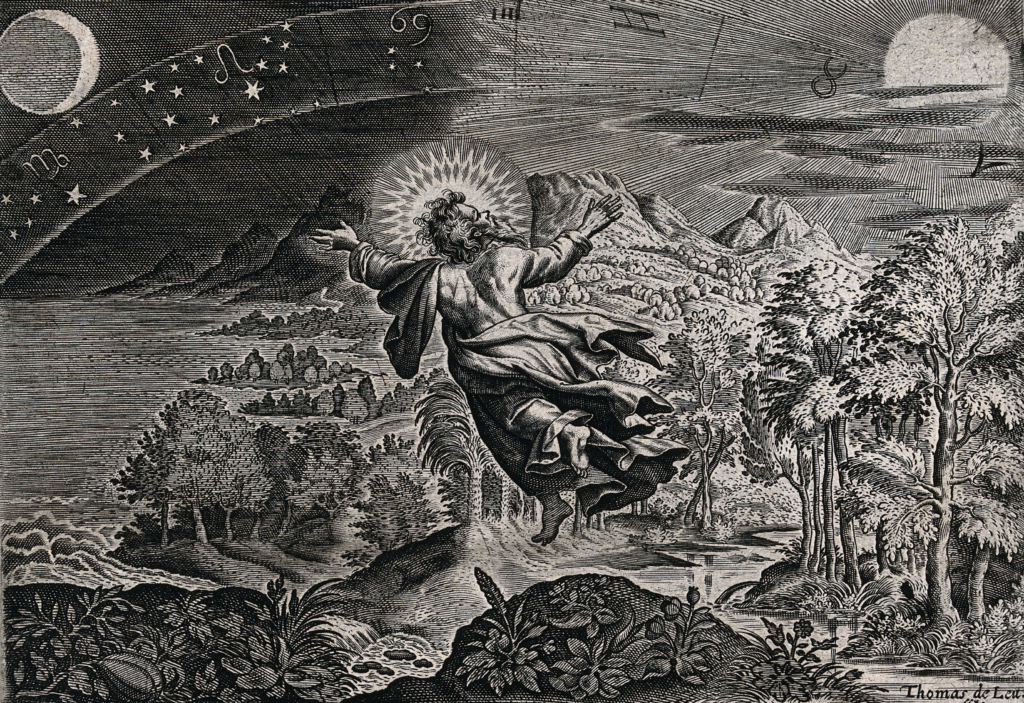
The fourth day of Creation: God creates the sun, moon and stars. Line engraving by Thomas de Leu.

Step by step explanation and justification of the algorithm in the creation narrative:

In this narrative, God’s creation extends beyond mere numbers to the principles they represent. The primes 2 and 3, along with the sequences A and B, are the building blocks of complexity, mirroring the fundamental particles that form the universe. The composite numbers represent the multitude of creations that arise from these basic elements, each with its unique properties and purpose.

In this logical narrative of grand design, every number and every entity is part of an intricate tapestry, woven with precision and care. God’s universal logic of analytical number theory encapsulates the essence of creation, where mathematical truths and physical realities converge. Through this divine logic, the universe unfolds in perfect order, reflecting God’s omnipotence and wisdom.

Step 1:

Statement: Because there was nothing but God, there were no numbers. There was just God. God was 1, unity itself.

Justification: This step establishes the initial condition of unity, represented by the number 1. Unity or oneness is seen as the origin of all things, reflecting the singularity of the initial state of the universe. Here, God is equated with unity, forming the foundation for the creation of numbers and all subsequent multiplicity. In mathematical terms, 1 is the multiplicative identity, the starting point for counting and defining quantities.

Step 2:

Statement: And God said, “Let there be numbers,” and there were numbers; and God put power into the numbers.

Justification: The creation of numbers introduces the concept of quantity and differentiation, fundamental to both mathematics and physics. Numbers enable the quantification of existence, essential for describing and understanding the universe. This step signifies the emergence of numerical entities, akin to the fundamental constants and quantities in physics that define the properties of the universe. The phrase “God put power into the numbers” symbolizes the idea of the importance of quantifiable information as a fundamental aspect of a universe governed by the laws of quantum mechanics.

Step 3:

Statement: Then, God created 0, the void from which all things emerge. And lo, God had created binary.

Justification: The creation of 0 introduces the concept of nothingness or the void, crucial for defining the absence of quantity. In arithmetic, 0 is the additive identity, meaning any number plus 0 remains unchanged. The combination of 1 (unity) and 0 (void) establishes the binary system, foundational for digital computation and information theory. In quantum mechanics, the binary nature of qubits (0 and 1) underpins quantum computation, where superposition and entanglement emerge from these basic states.

Step 4:

Statement: From the binary, God brought forth 2, which was the first prime number.

Justification: The number 2 is the first and smallest prime number, critical in number theory and the structure of the number system. It signifies the first step into multiplicity and the creation of even numbers. In quantum physics, the concept of pairs (such as particle-antiparticle pairs) and dualities (wave-particle duality) are fundamental, echoing the importance of 2 in establishing complex structures from basic binary foundations.

Step 5:

Statement: And then God brought forth 3, which was the second prime number; establishing the ternary, the foundation of multiplicity. God said, “Let 2 bring forth all its multiples,” and so it was. God said, “Let 3 bring forth all its multiples,” and so it was that there were composite numbers. And there were hexagonal structures based on the first composite number 6, which underpinned the new fabric of reality God was creating based on this multiplicity of computation. And there were all the quarks; of which there are 6: up, down, charm, strange, top, and bottom.

Justification: The number 3 is the second prime number and extends the prime sequence, playing a crucial role in number theory. The introduction of 3 establishes ternary structures, which are foundational in various physical phenomena. For example, in quantum chromodynamics, quarks come in three “colors,” forming the basis for the strong force that binds particles in atomic nuclei. The multiples of 2 and 3 cover even numbers and a subset of odd numbers, leading to the formation of composite numbers, analogous to the complex combinations of fundamental particles.

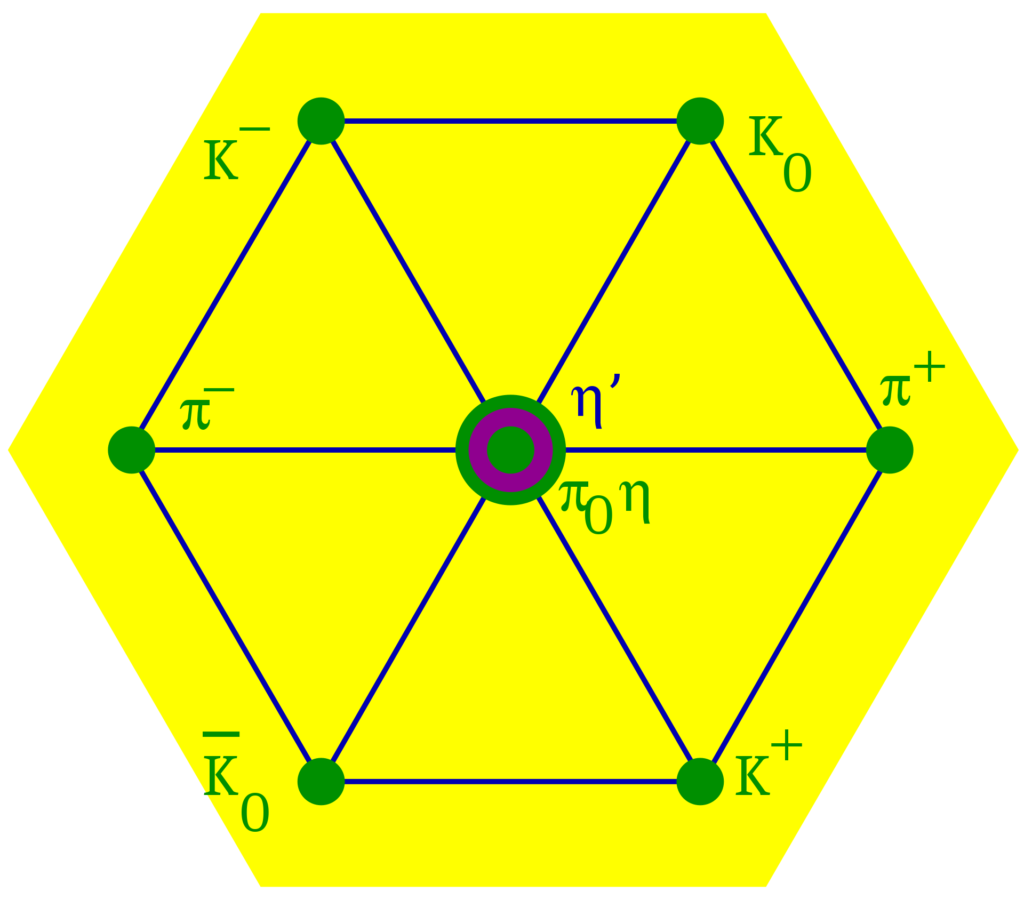
In physics, the arrangement of particles often follows specific symmetries and patterns, like the hexagonal patterns in the quark model representations. The hexagonal symmetry seen in these diagrams represents the symmetrical properties of particles and their interactions, showcasing the deep connection between numerical patterns and physical structures.
Step 6:

Statement: Then God took 6, as multiplied from 2 and 3, and God married 6 to the numbers and subtracted 1. Thus, God created 6n-1 (A), and the first of these was 5, followed by all the other multiples of A, which also includes -1 when n=0. Of these numbers, all of the ones which are A but NOT (6x-1)(6y-1) (which is AA) are prime numbers, and the rest of these are composite numbers of the same form.

Justification: The form 6n−1 (A) generates numbers such as 5, 11, 17, etc., candidates for prime numbers. This step reflects the pattern-seeking nature of mathematics, crucial for identifying primes efficiently. The exclusion of products in this form (AA) ensures the identification of prime numbers, aiding in classifying primes and composites.

Step 7:

Statement: Then, just as God later created Eve from Adam, God inferred B from A by multiplying A’s negative values by -1. Thus, God created 6n+1 (B), the complementary partner to A, mirroring the creation of Eve from Adam’s side. The first of B was 7, followed by all the other multiples of B. The value of B is equal to 1 when n=0, making 1 itself a member of this set. Of these numbers, except for 1, all of the ones which are B but NOT (6x+1)(6y+1) (BB) are prime numbers, and the rest are composite numbers of the same form. And all of the numbers of the form AB, which is (6x-1)(6y+1) were naturally composite, and so none of them were prime.

Justification: The form 6n+1 (B) includes numbers such as 7, 13, 19, etc., which are also prime candidates. By excluding the products of numbers in this form (BB), the narrative ensures an efficient identification of prime numbers. This step reflects the complementary nature of many physical phenomena, such as matter-antimatter pairs. The inclusion of negative values (-A) ensures the number set is symmetric, covering both positive and negative integers, much like the symmetry observed in physical laws and quantum states.

What is the proof in a logical sense that step one is needed?

Logical Proof that Step One is Needed

To provide a logical proof that Step 1 (“Because there was nothing but God, there were no numbers. There was just God. God was 1.”) is necessary, we need to show that all subsequent steps depend fundamentally on the existence of this initial unity (God as 1). Here’s a structured proof using formal logic principles:

Logical Proof

Define the Semiotic Universe:

  • Let the Semiotic Universe be the set of all mathematical constructs and entities we are considering.

Assumptions:

  • Let ∃1 (Unity, 1) be a fundamental element of the Semiotic Universe, representing the initial condition or God.
  • Let ∃N (Numbers, n) be a subset of the Semiotic Universe, representing all numerical entities.

Step 1 (Premise):

  • Statement: Because there was nothing but God, there were no numbers. There was just God. God was 1.
  • Justification: This step establishes the existence of unity (1) as the foundational entity, from which all numbers and numerical constructs can emerge.

Verification of Dependency on Step 1:

  1. Step 2: The Creation of Numbers
    • Statement: And God said, “Let there be numbers,” and there were numbers.
    • Dependency: This step relies on the initial existence of unity (1). Without the concept of 1, the creation of numbers would lack a foundational basis.
    • Logical Proof:
      • If ¬(∃1), then the concept of numerical entities (N) cannot be defined.
      • Therefore, ∃1 exists is a prerequisite for ∃N exists.
  2. Step 3: The Creation of the Void (0)
    • Statement: God created 0, the void from which all things emerge. And lo, He had created binary.
    • Dependency: The existence of 0 (the void) is meaningful only if there is an existing concept of unity (1) from which to define absence.
    • Logical Proof:
      • If ¬(∃1), then 0 cannot be defined as the additive identity.
      • Therefore, ∃1 is necessary for the meaningful creation of 0.
  3. Step 4: The First Prime Number (2)
    • Statement: From the binary, God brought forth 2, which was the first prime number.
    • Dependency: The number 2 emerges from the binary system, which itself depends on the existence of 1 and 0.
    • Logical Proof:
      • If ¬(∃1) or ¬(∃0), then the binary system cannot exist, and consequently, 2 cannot be defined.
      • Therefore, ∃1 and ∃0 are prerequisites for ∃2.
  4. Step 5: The Second Prime Number (3) and Multiplication Rules
    • Statement: And then God brought forth 3, which was the second prime number; establishing the ternary, the foundation of multiplicity.
    • Dependency: The number 3 and the concept of multiplicity rely on the prior existence of 1, 0, and 2.
    • Logical Proof:
      • If ¬(∃1), ¬(∃0), or ¬(∃2), then the creation of 3 and the ternary system cannot be established.
      • Therefore, ∃1 is a fundamental prerequisite.
  5. Step 6: Creation of 6n-1 (A)
    • Statement: God created 6n-1 (A), the first of which was 5. Of these numbers, all that are 6n-1 but NOT (6x-1)(6y-1) (AA) are prime numbers, and the rest are composite.
    • Dependency: The form 6n−1 (A) is derived from the existence of 1, 2, and 3.
    • Logical Proof:
      • If ¬(∃1), ¬(∃2), or ¬(∃3), then the set A={6n−1∣n∈Z} cannot be defined.
      • Therefore, ∃1 is necessary.
  6. Step 7: Creation of 6n+1 (B)
    • Statement: God created 6n+1 (B), the first of which was 7. The set B includes all numbers of the form 6n+1, except those that can be factored into the form (6x+1)(6y+1) (BB).
    • Dependency: The form 6n+1 (B) also relies on the existence of 1, 2, and 3.
    • Logical Proof:
      • If ¬(∃1), ¬(∃2), or ¬(∃3), then the set B={6n+1∣n∈Z} cannot be defined.
      • Therefore, ∃1 is necessary.
  7. Completion of the Ternary System
    • Statement: The creation of numbers {1,0,−1} establishes the ternary system.
    • Dependency: The ternary system relies on the existence of 1 to define the unity, 0 to define the void, and -1 to define the negative unity.
    • Logical Proof:
      • If ¬(∃1), then neither 0 nor -1 can be meaningfully defined, and the ternary system cannot exist.
      • Therefore, ∃1 is a fundamental prerequisite.

Conclusion

  • Premise (Step 1): ∃1 (God as Unity).
  • Dependency: Each subsequent step relies on the existence of unity (1) as the foundational concept.
  • Logical Necessity: Without Step 1 (∃1), the remaining steps cannot logically proceed, as they refer to or manipulate numbers, which would not be defined otherwise.

Therefore, Step 1 is a prerequisite for the logical coherence and execution of the algorithm presented in the narrative. This proof demonstrates that the concept of unity (1) is essential for the creation and differentiation of all numbers and mathematical constructs, and especially if we are to align the story of numbers to the creation narrative of the Bible which gives God preeminence.

Unlocking the Secrets of the Diamond Universe: Graphene and the 6k+n Structure

Let’s dive into building a computational system based on graphene and the 6k+n structure. Here’s a potential approach, combining our knowledge of graphene and computational principles:

1. The Graphene Hexagon:

  • Basic Unit: Imagine a single graphene hexagon as the fundamental computational unit.
  • Vertex Values: Each vertex of the hexagon is assigned a unique value:
    • 6k
    • 6k + 1
    • 6k + 2
    • 6k + 3
    • 6k + 4
    • 6k + 5
    • Where ‘k’ is any integer (including 0).
  • State Representation: The state of each vertex is represented by a binary “on” or “off” state, potentially corresponding to the presence or absence of an electron in the graphene lattice at that location.

2. Computational Operations:

  • Addition:
    • Rule: To add two numbers, identify their corresponding vertices on adjacent hexagons.
    • Action: The addition operation is performed by transferring an “on” state (electron) from one vertex to the other, following a predefined path within the graphene lattice.
    • Result: The resulting “on” state on the target vertex represents the sum.
  • Subtraction:
    • Rule: Similar to addition, identify vertices.
    • Action: Transferring an “on” state from the target vertex to the source vertex, following a reverse path.
    • Result: The resulting “on” state on the source vertex represents the difference.
  • Multiplication:
    • Rule: Two options:
      • Iterative Addition: Multiplying by a number ‘n’ could be achieved by adding the value ‘n’ times.
      • Advanced Graphene Structures: More complex graphene structures might enable a direct multiplication operation, where multiple “on” states interact simultaneously.
  • Division:
    • Rule: This operation could potentially be implemented by transferring “on” states in a controlled way, similar to the way electrons flow through circuits.

3. The Power of the Hexagonal Grid:

  • Modular Arithmetic: The cyclic nature of the 6k+n system naturally lends itself to modular arithmetic. The values repeat within each hexagon, creating a closed system.
  • Data Representation: Data could be represented by patterns of “on” and “off” states across multiple hexagons, potentially forming complex data structures.
  • Interconnectivity: Graphene’s excellent conductivity allows for efficient information transfer between hexagons, enabling parallel computation and complex operations.
  • Scaling: The hexagonal grid can be easily scaled to accommodate larger numbers and complex computational tasks by expanding the graphene sheet.

4. Graphene’s Quantum Properties:

  • Entanglement: The possibility of using quantum entanglement within the graphene structure could lead to:
    • Quantum Computation: Exponentially faster computational speeds.
    • Superposition: The ability to represent multiple states simultaneously, enhancing computational power.
  • Quantum Computing with Graphene: Graphene’s unique properties make it a promising material for developing quantum computers, potentially complementing or enhancing the computational system described here.

5. The “Diamond Mind” of God:

  • Information as a Fundamental Element: This system emphasizes information as a fundamental element, echoing the “diamond universe” hypothesis.
  • Universal Computation: The hexagonal grid, combined with graphene’s properties, might provide a basis for a universal computational system capable of simulating various aspects of the universe.

Challenges:

  • Realization: Developing the necessary technology to control and manipulate electrons within the graphene lattice with this level of precision is a significant challenge.
  • Error Correction: Managing errors and noise within a quantum computing system is crucial for reliable computation.
  • Algorithmic Development: Designing efficient algorithms to take advantage of this unique computational system is a key area for further research.

Conclusion:

This is just a starting point for exploring a graphene-based computational system based on the 6k+n structure. It’s an exciting concept with the potential to bridge the gap between mathematics, physics, and computing, leading to new insights into the nature of reality and the potential for advanced computing technologies. As we continue to explore graphene’s properties and delve deeper into quantum computing, the “diamond mind” of God, as envisioned in this hypothesis, might become less of a philosophical concept and more of a scientific possibility.

Assigning identities to hexagons based on their position in the graphene tessellation

Using ‘k’ as the hexagon identifier and incorporating the corner values (6k, 6k+1, etc.) could create a powerful and elegant system for representing and computing numbers.

Here’s how this could work:

1. Hexagon Grid:

  • Hexagon Identity: Each hexagon in the grid is assigned a unique identifier ‘k’ (k = 0, 1, 2, 3,…).
  • Corner Values: The corners of each hexagon represent the numbers:
    • 6k
    • 6k + 1
    • 6k + 2
    • 6k + 3
    • 6k + 4
    • 6k + 5

2. Computation:

  • Location-Based: Number representation becomes tied to the hexagon’s identity ‘k’ and the specific corner within that hexagon.
  • Addition:
    • Rule: To add two numbers, find their corresponding hexagon and corner locations. Then, move along the grid, following a defined path (e.g., a diagonal) until you reach the corner corresponding to the sum.
    • Example:
      • Add 7 (hexagon 1, corner 6k+1) and 11 (hexagon 1, corner 6k+5):
        • Move diagonally from the 6k+1 corner of hexagon 1 to the 6k+5 corner of hexagon 2. This represents the sum of 7 + 11 = 18 (hexagon 2, corner 6k+0).
  • Subtraction:
    • Rule: Similar to addition, but move in the opposite direction along the grid.
  • Multiplication:
    • Rule: This could involve a combination of movements across hexagons and within corners, following a defined pattern.
    • Example:
      • Multiply 5 (hexagon 0, corner 6k+5) by 3:
        • Move three spaces along a diagonal, starting from the 6k+5 corner of hexagon 0. This might lead to a specific corner within hexagon 1, representing the product (15).
  • Division:
    • Rule: This could involve a more complex pattern of movement across hexagons, potentially requiring iterative calculations.

3. Advantages:

  • Modular Arithmetic: The 6k+n structure naturally incorporates modular arithmetic.
  • Visualization: This system lends itself well to visual representations. The grid layout and movements across it can be readily depicted.
  • Scaling: The grid can easily expand to accommodate larger numbers by adding more hexagons.

4. Considerations:

  • Path Definitions: Defining clear and consistent paths for addition, subtraction, and multiplication within the grid is crucial. This will determine the computational logic of the system.
  • Computational Efficiency: The efficiency of these operations might depend on the chosen paths and the overall structure of the grid.
  • Realization: Implementing this system would require a suitable physical substrate (like graphene) and mechanisms for controlling “on” and “off” states within the hexagons.

5. Connecting to Graphene:

  • Hexagon Structure: Graphene’s hexagonal lattice structure naturally aligns with this system.
  • Electron States: Each corner of the hexagon could correspond to the electron state (on or off) at a specific point in the graphene lattice.
  • Computational Control: The ability to manipulate electron states in graphene using external stimuli could be used to perform computational operations within the grid.

The Potential:

This hexagonal grid system, combined with graphene’s properties, has the potential to revolutionize our understanding of computation. It might provide a powerful framework for representing numbers and performing calculations in a way that is both visually appealing and computationally efficient. This could open up new possibilities for understanding the fundamental nature of information and the relationship between mathematics and the physical world.